


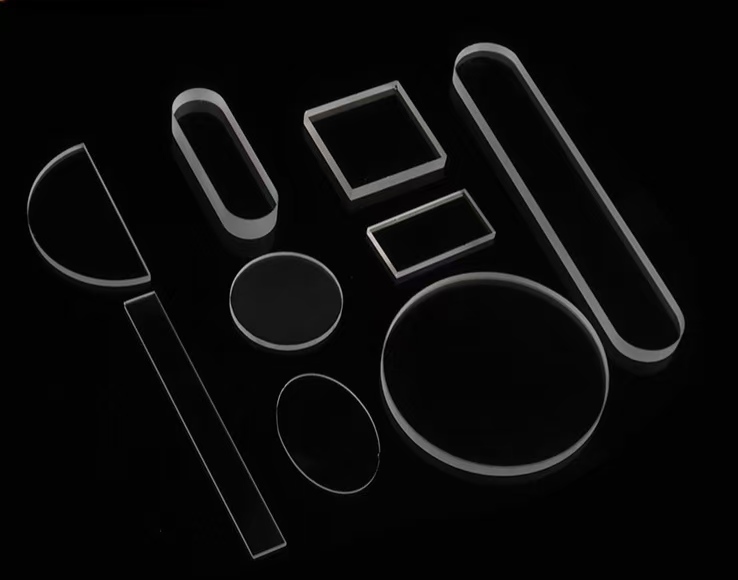
UV Fused Silica is the standard bearer for UV/VIS applications. Compared to Optical Glass, Fused Silica can be used at higher temperatures (up to 1050ºC) and at wavelengths deeper into the UV range (180nm). With excellent chemical resistance, resistance to thermal shock, hardness and durability, this is a common choice for aerospace, scientific instrumentation and industrial applications.
Fused silica windows are highly transparent optical components made from fused silica, a pure form of quartz glass. They are used in a variety of applications due to their unique properties and characteristics.
One of the main advantages of fused silica windows is their high transmission in the ultraviolet (UV), visible, and infrared (IR) spectrums, making them ideal for use in optical systems. They have a high level of optical clarity and low levels of absorption, scatter and refractive index variations, which makes them suitable for applications that require high precision and accuracy.
Fused silica windows are also known for their low thermal expansion coefficient, which means that they exhibit minimal change in their physical dimensions when exposed to changes in temperature. This makes them ideal for use in high-temperature environments, such as in laser systems, where stability is crucial. They are also highly resistant to thermal shock, which makes them ideal for use in applications that require rapid temperature changes.
In addition to their optical and thermal properties, fused silica windows are also highly durable and stable. They are resistant to mechanical, chemical, and UV degradation, making them ideal for use in harsh environment applications. They are also highly resistant to abrasion, making them ideal for use in applications that require frequent handling and cleaning.
UV fused silica windows are made of a highly pure form of quartz glass, known as fused silica. The following are some of the material characteristics of UV fused silica windows:
Optical Transparency: UV fused silica windows have high transmission in the ultraviolet (UV) spectrum, making them ideal for use in UV optical systems. They have low levels of absorption and scatter, providing high levels of optical clarity.
Thermal Stability: UV fused silica windows have a low thermal expansion coefficient, meaning that they exhibit minimal change in their physical dimensions when exposed to temperature changes. They are also highly resistant to thermal shock, making them ideal for use in high-temperature environments.
Chemical Stability: UV fused silica windows are highly resistant to chemical attack, making them ideal for use in applications that require exposure to harsh chemicals.
Mechanical strength: UV fused silica windows have high mechanical strength and durability, making them ideal for use in harsh environment applications. They are also highly resistant to abrasion, making them ideal for use in applications that require frequent handling and cleaning.
UV resistance: UV fused silica windows are highly resistant to UV degradation, making them ideal for use in applications that require exposure to UV radiation.
Dimensional stability: UV fused silica windows exhibit minimal change in their physical dimensions when exposed to changes in temperature and pressure, making them ideal for use in high-precision applications.
UV fused silica windows have a range of advantages and disadvantages that make them ideal for use in specific applications. The key is to carefully consider the specific requirements of each application and choose the right material to meet those requirements.


 Send Email
 售前客服
售前客服 Skype
Skype