



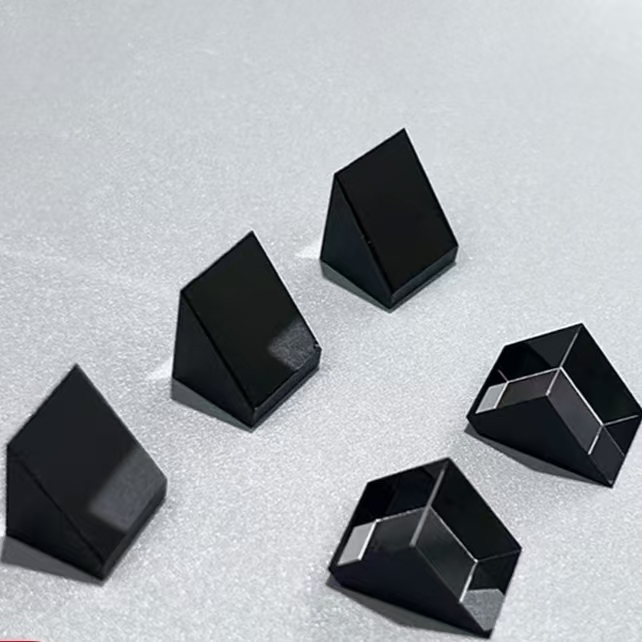
Refraction: Light bends as it enters and exits the prism because of the change in material density and angled faces.
Dispersion: Different colors of light bend at different angles, separating white light into a rainbow spectrum.
Reflection: Internal surfaces bounce light inside the prism to redirect its path without needing a traditional mirror coating
Main Types of Prisms
right angle prism
roof prism
equilateral prism
dove prisms
penta prism
Retroreflectors
Light pipe homogenizing rods
Microprisms
Dispersive Prisms: Equilateral or triangular shapes used to split white light into constituent wavelengths for spectroscopy.
Reflecting / Deflecting Prisms: Right-angle or Porro prisms that bend light paths by specific angles (like 90° or 180°) and fold optical systems into smaller spaces.
Rotating / Imaging Prisms: Dove or roof prisms that rotate, invert, or correct the orientation of an image.
Common Applications
Scientific Instruments: Used in spectrometers, refractometers, and lasers for light analysis and beam alignment.
Optical Equipment: Used in binoculars, periscopes, and cameras to erect upside-down images and shorten device size.
Vision Correction: Specialized prism lenses can be added to eyeglasses to shift images and treat double vision caused by eye misalignment


 Send Email
 售前客服
售前客服 Skype
Skype