


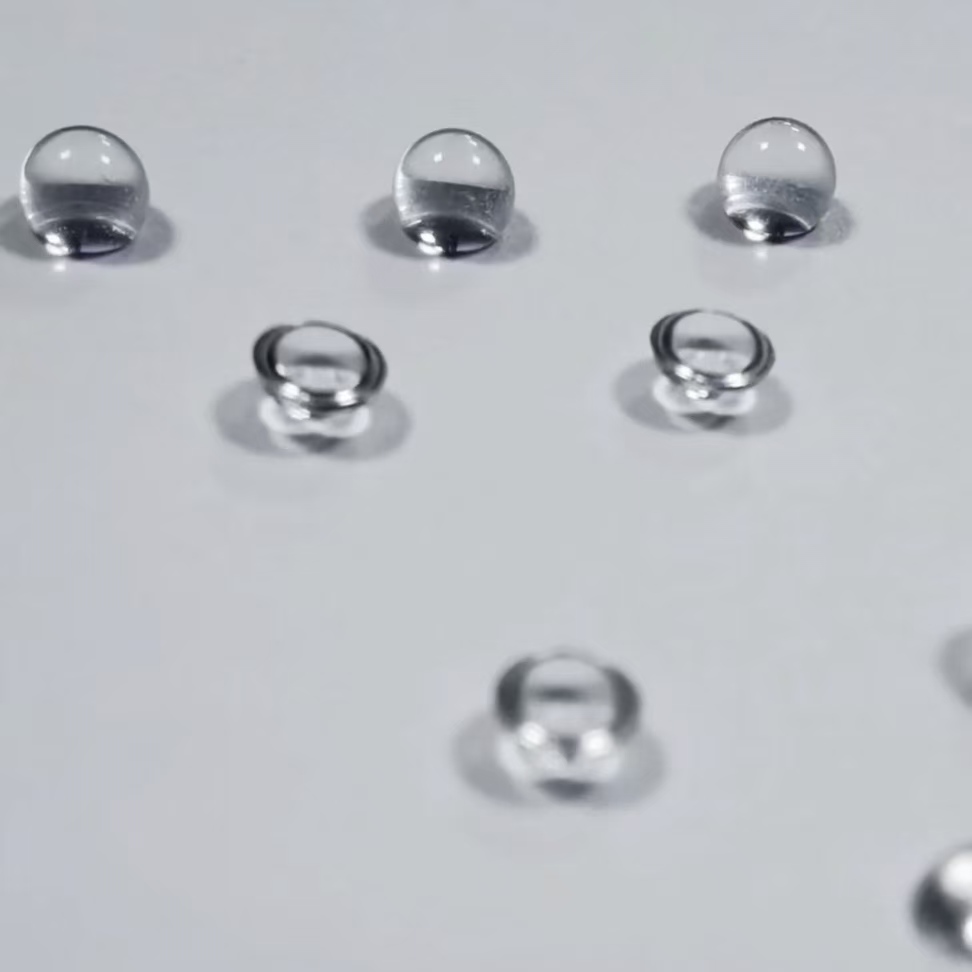
Ball lenses are great optical components for improving signal coupling between fibers, emitters, and detectors. They are also used in endoscopy, bar code scanning, ball pre-forms for aspheric lenses, and sensor applications. Ball lenses are manufactured from a single substrate of glass and can focus or collimate light, depending upon the geometry of the input source. Half-ball lenses are also common and can be interchanged with full ball lenses if the physical constraints of an application require a more compact design.
While ball lenses can be made from any optical glass, specific materials are favored based on the required refractive index and environmental robustness,
The manufacture of ball lenses begins with cutting rods of the chosen material into small cylindrical preforms slightly larger than the final diameter. These preforms are rounded into near-spherical shapes by one of several methods:
flame melting, in which surface tension forms molten glass into spheres
mechanical grinding, where the pieces are rotated between concave laps
precision molding, in which molten or softened glass is pressed into spherical molds
Following rough shaping, the spheres undergo fine grinding with progressively finer abrasive slurries – commonly silicon carbide or diamond – to improve the sphere shape and bring the size close to specification. They are then polished on pitch or polyurethane pads using fine polishing compounds such as cerium oxide.
After polishing, the lenses are cleaned ultrasonically and inspected for dimensional accuracy, surface finish, and optical performance using interferometric and profilometric methods. Parameters such as focal length and refractive index uniformity are verified, and defective parts are rejected. High-quality lenses may then receive anti-reflection coatings or protective coatings by vapor deposition.
The half ball lens is a lens cut from a part of a spherical surface, with a cross-section that appears semicircular. Compared to other lenses, the half ball lens has a certain convex lens effect and is used in optical systems for focusing, imaging, and magnification.
The working principle of the half ball lens is based on the convex lens effect of the lens, which focuses or diffuses light through the lens. When light passes through the half ball lens, it will be refracted by the front surface of the lens, and then reflected and refracted by the back surface of the lens, finally converging at a focal point or undergoing a certain degree of diffusion.
Although the half ball lens is also a type of lens, it has the following differences compared to other lenses:
Special shape: The cross-section of the half ball lens is semicircular, while other lenses are circular or other shapes.
Different functions: The half ball lens has a certain convex lens effect, while other lenses may have convex, concave, or splitter lens effects.
Different uses: Half ball lenses are generally used for focusing, imaging, and magnification, while other lenses may be used for filtering, splitting, light path direction, and laser beam control.
The half ball lens is an optical component widely used in optical instruments, photography, and image processing. In daily applications, we must choose appropriate materials and lens coatings according to its special convex lens effect and shape structure to meet the needs of different optical systems.
Lens Type | Ball lenses, half-ball lenses | Materials | Optical grade single crystal sapphire, ruby |
Diameter Range | ~300mm | Diameter Tolerance | ±0.1mm |
Surface Roughness | as per your need | Surface Quality | Option: 80/50, 60/40, 40/20 or 20/10 S/D |
Coating | according to customer's requirement |


 Send Email
 售前客服
售前客服 Skype
Skype