



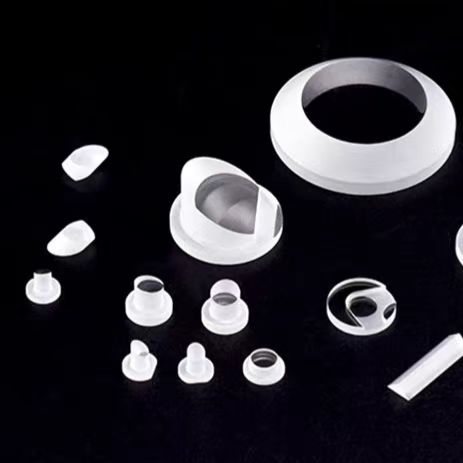
Borosilicate glass refers to a glass (inert transparent solid) including more than 5% of Boric oxide (B2O3) mixed with SiO2, Al2O3 and Na2O. It has a very clear optical transparency and good mechanical properties. Borosilicate is also often used for its resistance to temperature, temperature shocks and chemical agents.
Resistance to temperature shocks, makes borosilicate the perfect material to be used in making cookware that won’t break when taken out of oven and contact much colder material. Also, the heat and chemical (both alkali and acid) resistance are the reason why borosilicate is a material seen in many laboratory equipment.
Colored borosilicate
Adding ppm of chemical element can produce very stable colored borosilicate material.
For exemple, Fe element will produce green glass, gold elements will make the glass red, while copper and cobalt will be used for blue colors.
Borofloat is manufactured with the same process as float glass, making cheap very flat glass material plates of different thickness. Therefore borosilicate is a material of choice
One of the most common optical glass, Schott N-BK7 is a crown borosilicate
What is the difference between borosilicate and normal glass ?
The main difference, as its name put it is the presence of Boron in the material, which enable a resistance to higher temperatures than soda-lime glass but also borosilicate need to be produced at higher temperatures making it more expensive to produce.
Borosilicate glass has a 3 times higher thermal expansion coefficient making it much better at handling thermal shocks.
Both materials can be produced in flat plates with the float process, float Soda-lime is usually referred as “Float” and borosilicate differentiated as “Borofloat”.
Whereas soda-lime glass has a greenish color borosilicate is very clear, it even can be used for high quality optics while soda-lime glass is seldom used only for low quality optics.


 Send Email
 售前客服
 Skype