



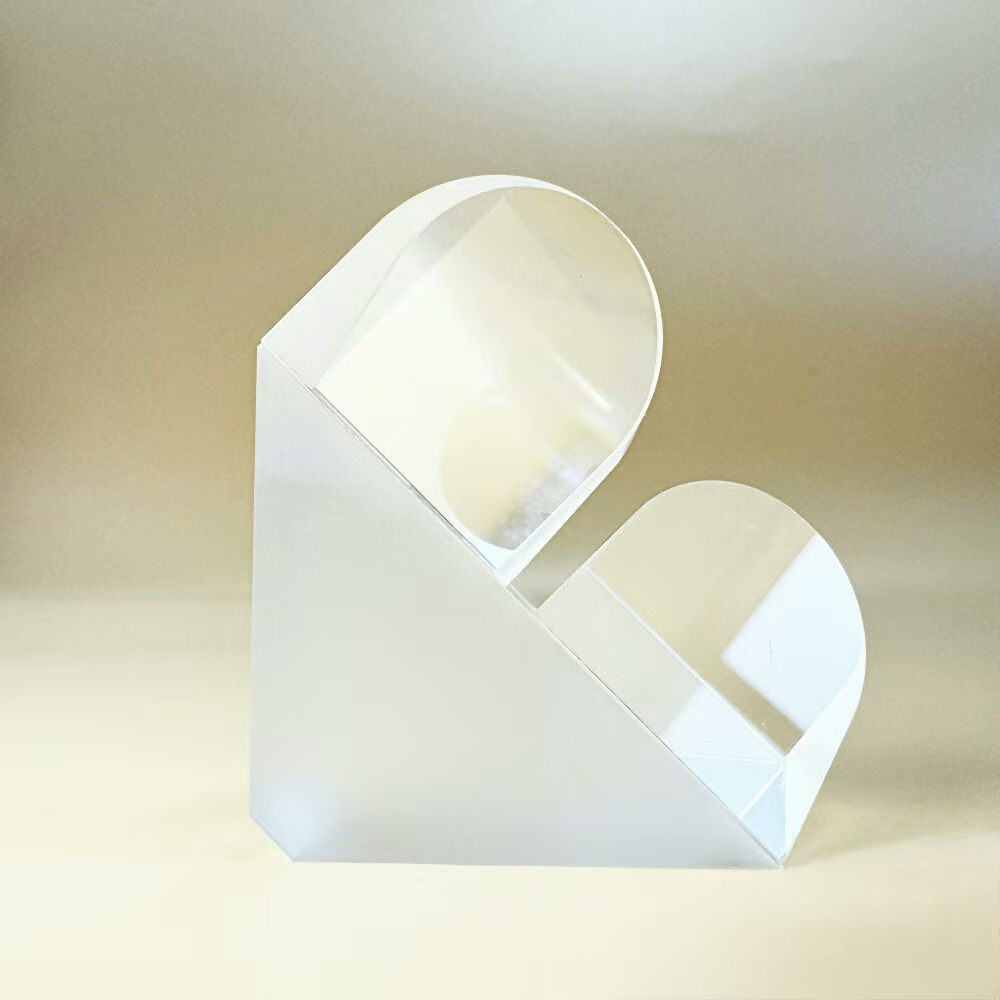
optical prisms are useful for a wide range of applications. Our extensive collection of optical prisms includes various shapes and configurations, such as right-angle, dispersing, roof, dove, retro-reflecting, penta, and wedge prisms as well as hexagonal light mixing rods.
high-precision Right-Angle Prisms can be used to deviate a light path by 90° or 180°, depending on which surface is used as the input for the light source. These prisms are fabricated from N-BK7, UV fused silica, CaF2, or ZnSe, and they are offered in sizes ranging from 3 mm to 200 mm.
Dove prismis used to rotate, invert, or retroreflect an image, depending upon the prism's rotation angle and the surface through which the light enters the prism.
Roof Prism can be used when a right angle deflection of an image or laser beam is required. In passing through the prism, the image is both deflected right-to-left and top-to-bottom. The hypotenuse of the prism utilizes total internal reflection (TIR) to reflect the image through the prism. Polarization states may become rotated during reflection.
Retroreflectors reflect an image or beam back 180° toward its original direction. Prisms achieve this either through total internal reflections (TIR) or specular reflections, depending on whether the reflective faces are coated. "Hollow" retroreflector mirrors employ first-surface specular reflections in order to eliminate dispersion, chromatic aberrations, and material absorption inherent in prisms.
including retroreflector prisms and mirrors (a.k.a. corner cubes), a lateral transfer retroreflector, hollow roof mirrors, right-angle (a.k.a. porro) prisms, and Dove prisms. Fiber optic retroreflector patch cables reflect light input through the connector backward through the fiber and can be used to create a fiber interferometer or to build a low-power fiber laser.
Wedge Prisms are ideal for laser beam steering applications. Also known as Risley prisms, these optics deflect a beam normal to the prism's perpendicular surface through an angular deviation ranging from 2° to 10°
| Prism | Material | Deviation | Invert | Reverse or Rotate | Illustration | Applications |
|---|---|---|---|---|---|---|
| Right Angle Prisms | N-BK7, UV Fused Silica, Calcium Fluoride, or Zinc Selenide | 90° | 90° | No | 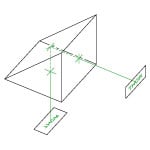 | 90° reflector used in optical systems such as telescopes and periscopes. |
| 180° | 180° | No | 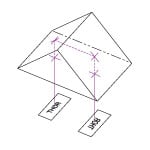 | 180° reflector, independent of entrance beam angle. Acts as a non-reversing mirror and can be used in binocular configurations. | ||
| TIR Retroreflectors (Unmounted and Mounted) and Specular Retroreflectors (Unmounted and Mounted) | N-BK7 | 180° | 180° | No | 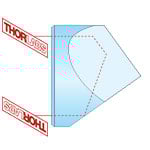 | 180° reflector, independent of entrance beam angle. Beam alignment and beam delivery. Substitute for mirror in applications where orientation is difficult to control. |
| Unmounted Penta Prisms and Mounted Penta Prisms | N-BK7 | 90° | No | No | 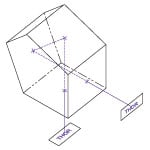 | 90° reflector, without inversion or reversal of the beam profile. Can be used for alignment and optical tooling. |
| Roof Prisms | N-BK7 | 90° | 90° | 180o Rotation | 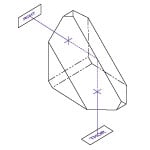 | 90° reflector, inverted and rotated (deflected left to right and top to bottom). Can be used for alignment and optical tooling. |
| Unmounted Dove Prisms and Mounted Dove Prisms | N-BK7 | No | 180° | 2x Prism Rotation | 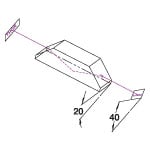 | Dove prisms may invert, reverse, or rotate an image based on which face the light is incident on. Prism in a beam rotator orientation. |
| 180° | 180° | No | 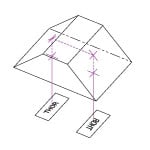 | Prism acts as a non-reversing mirror. Same properties as a retroreflector or right angle (180° orientation) prism in an optical setup. | ||
| Wedge Prisms | N-BK7 | Models Available from 2° to 10° | No | No | 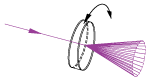 | Beam steering applications. By rotating one wedged prism, light can be steered to trace the circle defined by 2 times the specified deviation angle. |
| No | No | 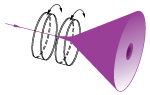 | Variable beam steering applications. When both wedges are rotated, the beam can be moved anywhere within the circle defined by 4 times the specified deviation angle. | |||
| Coupling Prisms | Rutile (TiO2) or GGG | Variablea | No | No | 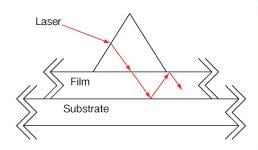 | High index of refraction substrate used to couple light into films. Rutile used for nfilm > 1.8 GGG used for nfilm < 1.8 |
Dispersive Prisms
| Prism | Material | Deviation | Invert | Reverse or Rotate | Illustration | Applications |
|---|---|---|---|---|---|---|
| Equilateral Prisms | F2, N-F2, N-SF11, Calcium Fluoride, or Zinc Selenide | Variablea | No | No | 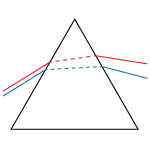 | Dispersion prisms are a substitute for diffraction gratings. Use to separate white light into visible spectrum. |
| Dispersion Compensating Prism Pairs | Fused Silica, Calcium Fluoride, SF10, or N-SF14 | Variable Vertical Offset | No | No | 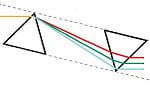 | Compensate for pulse broadening effects in ultrafast laser systems. Can be used as an optical filter, for wavelength tuning, or dispersion compensation.
|
| Pellin Broca Prisms | N-BK7, UV Fused Silica, or Calcium Fluoride | 90° | 90° | No | 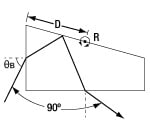 | Ideal for wavelength separation of a beam of light, output at 90°. Used to separate harmonics of a laser or compensate for group velocity dispersion. |
Beam Manipulating Prisms
| Prism | Material | Deviation | Invert | Reverse or Rotate | Illustration | Applications |
|---|---|---|---|---|---|---|
| Anamorphic Prism Pairs | N-KZFS8 or N-SF11 | Variable Vertical Offset | No | No | 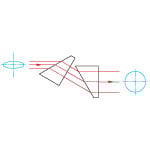 | Variable magnification along one axis. Collimating elliptical beams (e.g., laser diodes) Converts an elliptical beam into a circular beam by magnifying or contracting the input beam in one axis. |
| Axicons (UVFS, ZnSe) | UV Fused Silica or Zinc Selenide | Variablea | No | No |  | Creates a conical, non-diverging beam with a Bessel intensity profile from a collimated source. |
Polarization Altering Prisms
| Prism | Material | Deviation | Invert | Reverse or Rotate | Illustration | Applications |
|---|---|---|---|---|---|---|
| Glan-Taylor, Glan-Laser, and α-BBO Glan-Laser Polarizers | Glan-Taylor: Calcite Glan-Laser: α-BBO or Calcite | p-pol. - 0° s-pol. - 112°a | No | No | 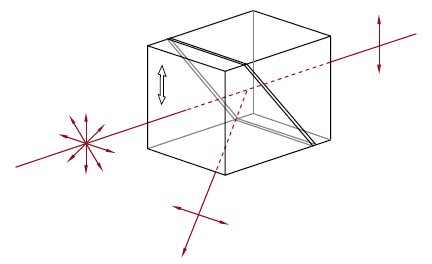 | Double prism configuration and birefringent calcite produce extremely pure linearly polarized light. Total Internal Reflection of s-pol. at the gap between the prism while p-pol. is transmitted. |
| Rutile Polarizers | Rutile (TiO2) | s-pol. - 0° p-pol. absorbed by housing | No | No | 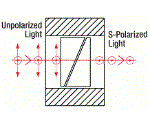 | Double prism configuration and birefringent rutile (TiO2) produce extremely pure linearly polarized light. Total Internal Reflection of p-pol. at the gap between the prisms while s-pol. is transmitted.
|
| Double Glan-Taylor Polarizers | Calcite | p-pol. - 0° s-pol. absorbed by housing | No | No | 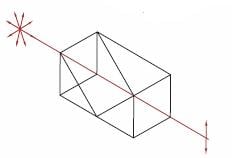 | Triple prism configuration and birefringent calcite produce maximum polarized field over a large half angle. Total Internal Reflection of s-pol. at the gap between the prism while p-pol. is transmitted. |
| Glan Thompson Polarizers | Calcite | p-pol. - 0° s-pol. absorbed by housing | No | No | 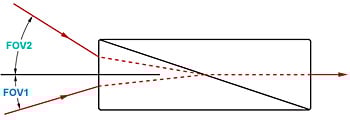 | Double prism configuration and birefringent calcite produce a polarizer with the widest field of view while maintaining a high extinction ratio. Total Internal Reflection of s-pol. at the gap between the prism while p-pol. is transmitted. |
| Wollaston Prisms and Wollaston Polarizers | Quartz, Magnesium Fluoride, α-BBO, Calcite, Yttrium Orthovanadate | Symmetric p-pol. and s-pol. deviation angle | No | No | 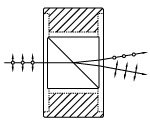 | Double prism configuration and birefringent calcite produce the widest deviation angle of beam displacing polarizers. s-pol. and p-pol. deviate symmetrically from the prism. Wollaston prisms are used in spectrometers and polarization analyzers. |
| Rochon Prisms | Magnesium Fluoride or Yttrium Orthovanadate | Ordinary Ray: 0° Extraordinary Ray: deviation angle | No | No | 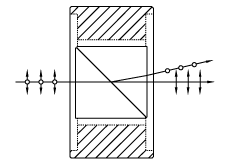 | Double prism configuration and birefringent MgF2 or YVO4 produce a small deviation angle with a high extinction ratio. Extraordinary ray deviates from the input beam's optical axis, while ordinary ray does not deviate. |
| Beam Displacing Prisms | Calcite | 2.7 or 4.0 mm Beam Displacement | No | No | 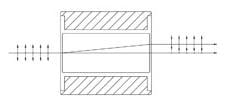 | Single prism configuration and birefringent calcite separate an input beam into two orthogonally polarized output beams. s-pol. and p-pol. are displaced by 2.7 or 4.0 mm. Beam displacing prisms can be used as polarizing beamsplitters where 90o separation is not possible. |
| Fresnel Rhomb Retarders | N-BK7 | Linear to circular polarization Vertical Offset | No | No | 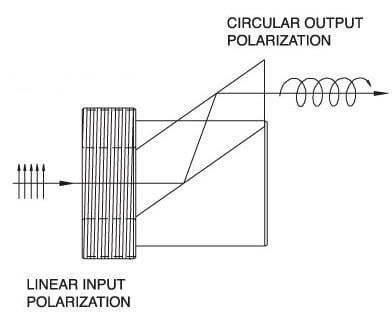 | λ/4 Fresnel Rhomb Retarder turns a linear input into circularly polarized output. Uniform λ/4 retardance over a wider wavelength range compared to birefringent wave plates. |
| Rotates linearly polarized light 90° | No | No | 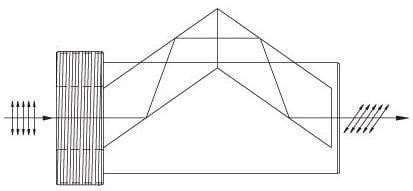 | λ/2 Fresnel Rhomb Retarder rotates linearly polarized light 90°. Uniform λ/2 retardance over a wider wavelength range compared to birefringent wave plates. |
Beamsplitter Prisms
| Prism | Material | Deviation | Invert | Reverse or Rotate | Illustration | Applications |
|---|---|---|---|---|---|---|
| Beamsplitter Cubes | N-BK7 | 50:50 splitting ratio, 0° and 90° s- and p- pol. within 10% of each other | No | No | 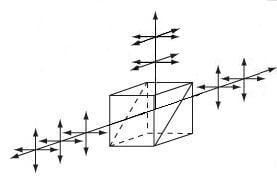 | Double prism configuration and dielectric coating provide 50:50 beamsplitting nearly independent of polarization. Non-polarizing beamsplitter over the specified wavelength range. |
| Polarizing Beamsplitter Cubes | N-BK7, UV Fused Silica, or N-SF1 | p-pol. - 0° s-pol. - 90° | No | No | 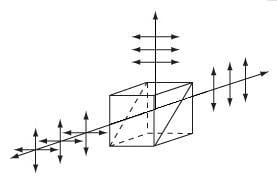 | Double prism configuration and dielectric coating transmit p-pol. light and reflect s-pol. light. For highest polarization use the transmitted beam. |


 Send Email
 售前客服
售前客服 Skype
Skype