


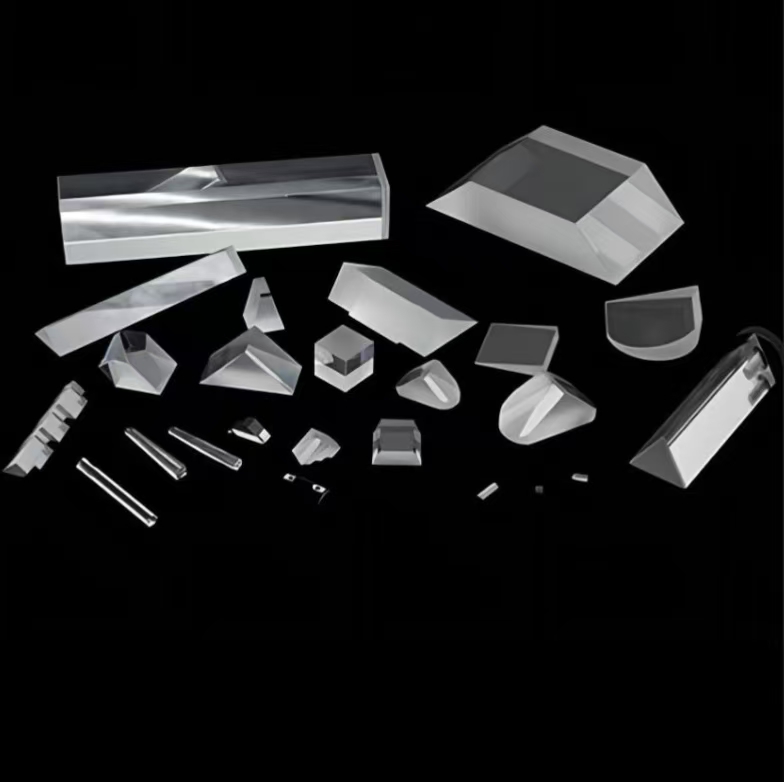
Prisms are used to fold up optical paths, manipulate image orientations and sizes, and diffract light. In many applications, a combination of prisms are used to achieve several of these effects. In order to design assemblies containing multiple prisms , it is important to understand where light enters, travels, and exits through each prism, and it may also be important to understand the optical path length of the light as it travels through the prism.
A ray starts outside of the prism and enters via one of the faces. Inside the prism, the ray contacts another of the prism’s faces. If the ray strikes the new surface at an angle equal to or greater than the critical angle (associated with the refractive indices of the interfacial media), or if this surface is coated with an appropriate mirror coating, then the light will be totally internally reflected or almost totally and internally reflected. When the ray reflects off of this surface, the cross-section, representing the prism, is flipped over the line representing the reflecting surface of the prism, such that the ray appears to continue straight through the next cross-section without changing its original direction through the first cross-section. If the ray strikes at an angle that is not greater than or equal to the critical angle, and the surface is not mirrored, then the light will pass through this surface and exit the prism.
Right Angle Prisms:
Ray deviation of 90° or 180°
Produce left-handed images due to a single reflection
Used in combination for image/beam displacement
Littrow Dispersion Prisms:
Ray deviation of 60° when coated
Produce right-handed images
Will disperse light into its component spectrum without reflections when uncoated
Penta Prisms:
Ray deviation of 90°
Produce left-handed images due to a single reflection
Slight shift of prism does not affect the true right angle at which rays are reflected
Amici Roof Prisms:
Ray deviation of 90°
Produce right-handed images
Roofed surface causes extra reflection
Dove Prisms:
Either used coated or uncoated
When uncoated, left-handed image rotates by twice the prism rotation angle
When coated, right-handed image reflected back towards itself
Half-Penta Prisms:
Deviate ray path by 45°
Right-handed image
Combined with Schmidt prisms to create Pechan prisms
Schmidt Prisms:
Deviate ray path by 45°
Right-handed image
Combined with half-penta prisms to create Pechan prisms
Pechan Prisms:
Inverts image, rotating it by 180°
Right-handed image
Combination of a Schmidt prism and half-penta prism
Rhomboid Prisms:
Lateral displacement of beam
Lateral displacement equivalent to prism length
Does not invert image
Please contact us if you have any need for them.


 Send Email
 售前客服
售前客服 Skype
Skype