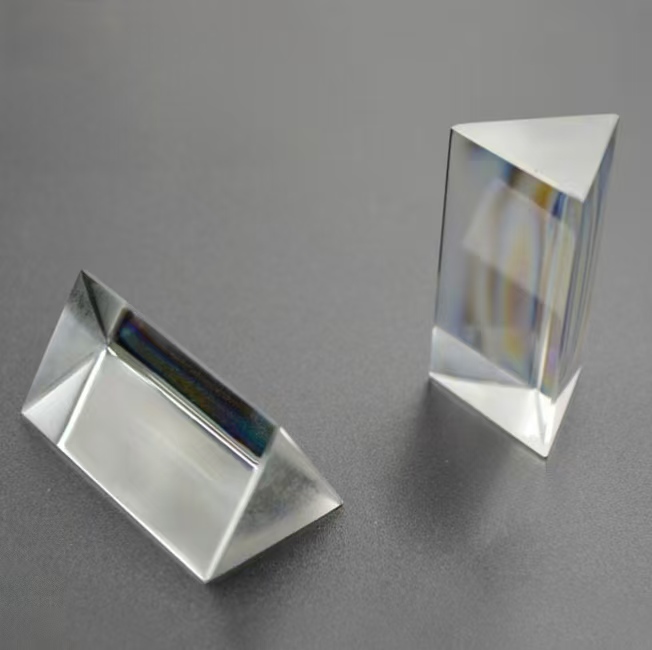
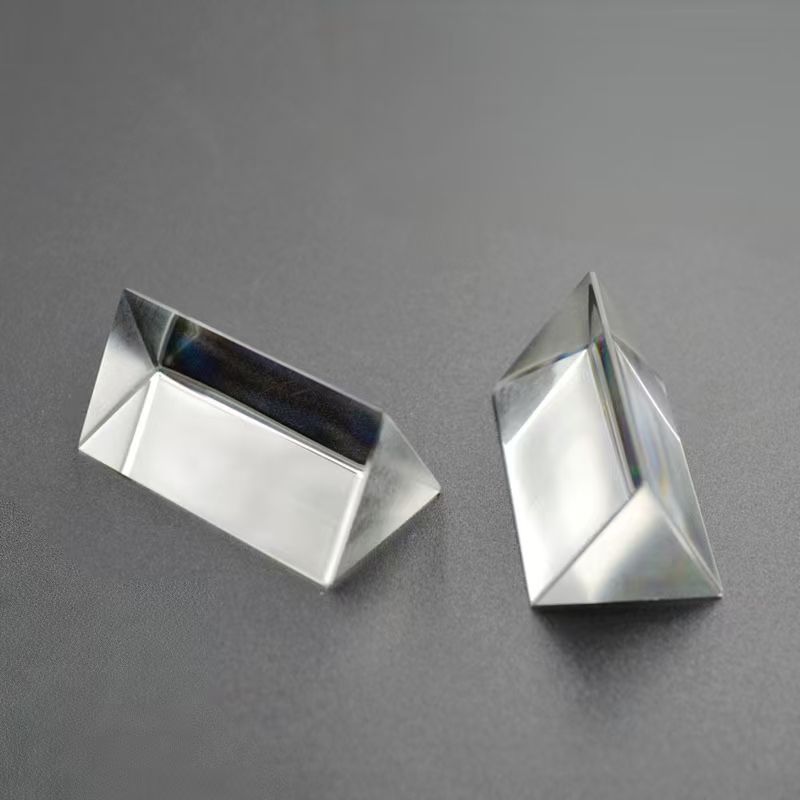
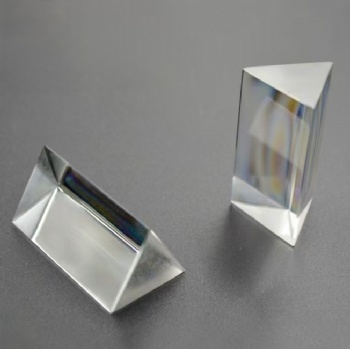
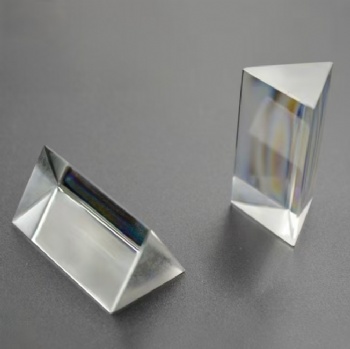
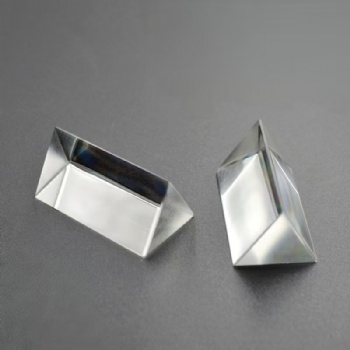
When a beam of white light enters one face, it is refracted at both the entrance and exit surfaces. Because the refractive index of the glass varies with wavelength (dispersion), different colors are bent by different amounts and emerge spatially separated, forming a spectrum. Minimum deviation occurs when the ray passes symmetrically through the prism (the angle of incidence equals the angle of emergence), which is the condition used for measuring a material's refractive index and Abbe number.
Equilateral prisms are widely used in demonstration and teaching of dispersion and total internal reflection, in spectrometers and monochromators, in wavelength-separation setups, and as beam-steering or turning elements. They are commonly made from optical glasses such as BK7 (N-BK7) or fused silica, and occasionally from higher-dispersion glasses like F2 or SF11 when strong dispersion is required.
Dispersion Prisms are used in applications that require separating the incident light into its component wavelengths. For example, when white light enters a Dispersion Prism, it is separated into its three components: red, green, and blue. Dispersion Prisms are ideal for spectroscopy or laser tuning.
| Parameter | Value |
|---|---|
| Material | N-BK7 (or fused silica, F2, SF11 on request) |
| Apex angle | 60° ± 3 arcmin |
| Surface quality | 60/40 scratch-dig , 40/20 |
| Surface flatness | λ/4 per face at 632.8 nm |
| Clear aperture | ≥ 80% of face dimension |
| Dimensional tolerance | ±0.1 mm |
| Angle tolerance | ±3 arcmin |
| Refractive index (n_d, 587.6 nm) | 1.5168 |
| Abbe number (V_d) | 64.17 |
| Refractive index homogeneity | 1×10⁻⁵ (standard), 5×10⁻⁶ (precision) |
| Coating | Uncoated (standard); AR coating on request |
| Edge/wavelength range | 350–2000 nm (BK7 transmission) |
| Bevel | Protective bevel on edges |
| Face dimensions (common sizes) | 10, 12.7, 20, 25, 25.4, 30, 50 mm |
| Minimum deviation (n=1.5168) | ≈ 38.6° |
Can be customized according to your requirements
spherical lens,plano-convex,plano concave lens,cylindrical lens,ball lens,halfball lens,optical windows,prism,optical filters.If you have any requirement,please contact us
Tags: spherical lens , plano-convex , plano concave lens , meniscus lens,cylindrical lens , ball lens , halfball lens , optical windows , prism , semi-circular prism , optical filters


 Send Email
 售前客服
 Skype