
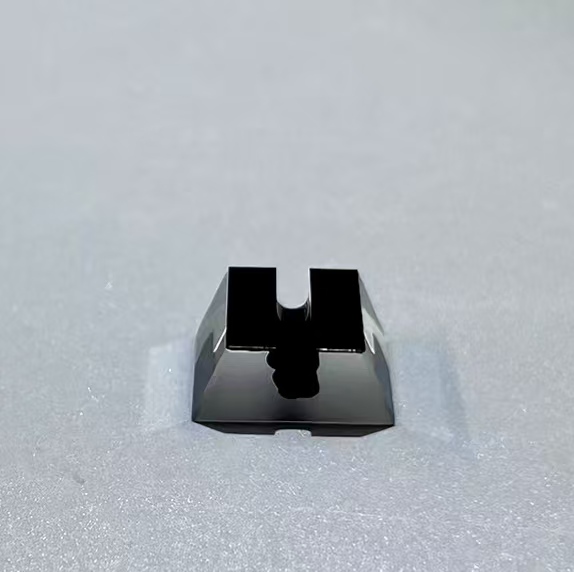
grooved prism is a prism whose optical faces carry a series of parallel machined, molded, or ruled grooves. The grooves modify how light interacts with the surface: depending on their depth and pitch, they can act as a diffraction grating, redirect or fan out light, or serve as alignment/fiducial features.
regularly spaced grooves on a prism face; whether it functions as a grating, a dispersion compensator, or simply a grooved refractive element depends on the groove spacing relative to the wavelength. For visible light, grooves with a pitch comparable to the wavelength (sub-micron to a few microns) give noticeable diffractive behavior; coarse grooves (tens of microns and up) behave as macroscopic surface structure.
| Parameter | Value |
|---|---|
| Material | N-BK7 (or fused silica, F2, SF11 on request) |
| Apex angle | 60° ± 3 arcmin |
| Surface quality | 60/40 scratch-dig , 40/20 |
| Surface flatness | λ/4 per face at 632.8 nm |
| Clear aperture | ≥ 80% of face dimension |
| Dimensional tolerance | ±0.1 mm |
| Angle tolerance | ±3 arcmin |
| Refractive index (n_d, 587.6 nm) | 1.5168 |
| Abbe number (V_d) | 64.17 |
| Refractive index homogeneity | 1×10⁻⁵ (standard), 5×10⁻⁶ (precision) |
| Coating | Uncoated (standard); AR coating on request |
| Edge/wavelength range | 350–2000 nm (BK7 transmission) |
| Bevel | Protective bevel on edges |
| Face dimensions (common sizes) | 10, 12.7, 20, 25, 25.4, 30, 50 mm |
| Minimum deviation (n=1.5168) | ≈ 38.6° |
Can be customized according to your requirements
spherical lens,plano-convex,plano concave lens,cylindrical lens,ball lens,halfball lens,optical windows,prism,optical filters.If you have any requirement,please contact us
Tags: spherical lens , plano-convex , plano concave lens , meniscus lens,cylindrical lens , ball lens , halfball lens , optical windows , prism , semi-circular prism , optical filters


 Send Email
 售前客服
 Skype