
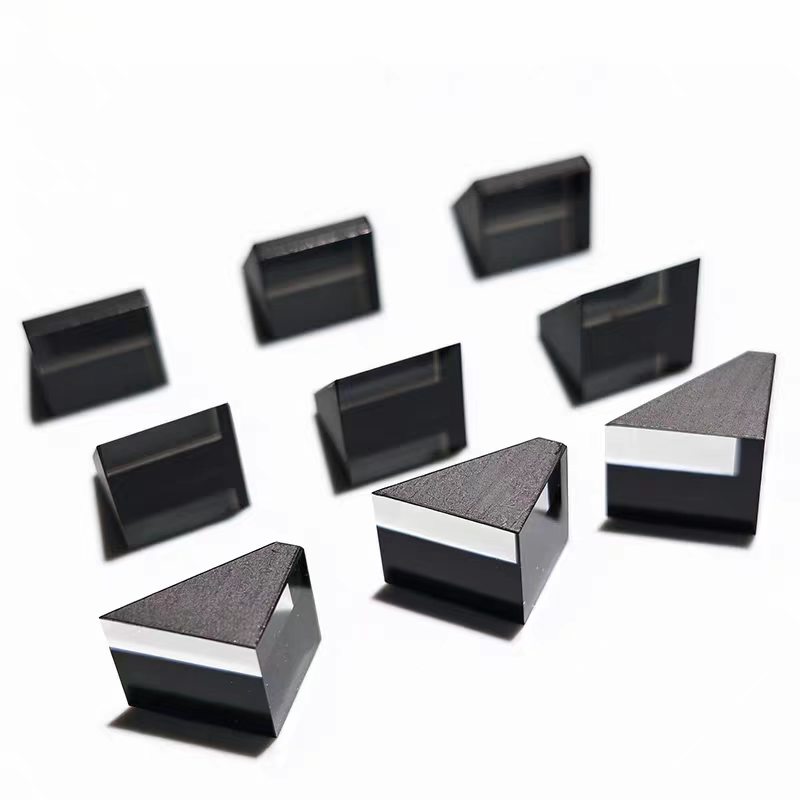
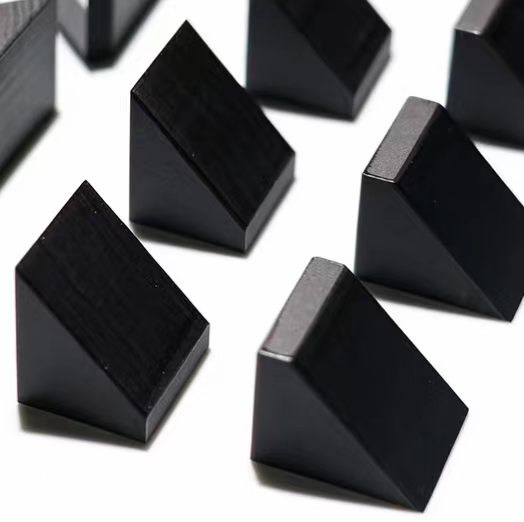
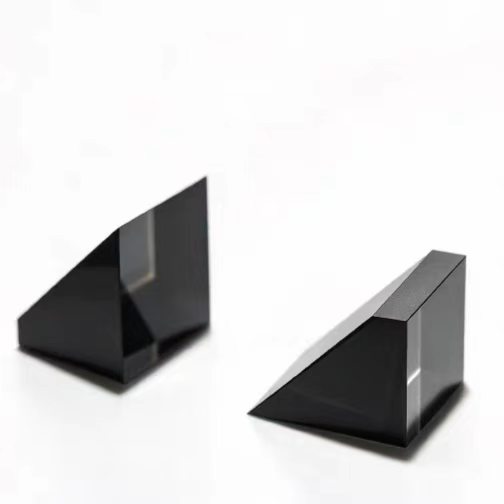
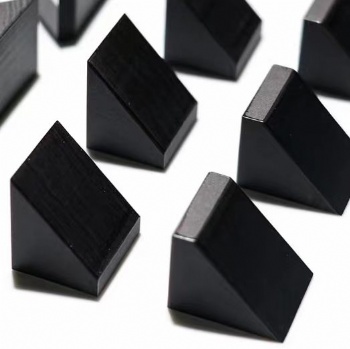
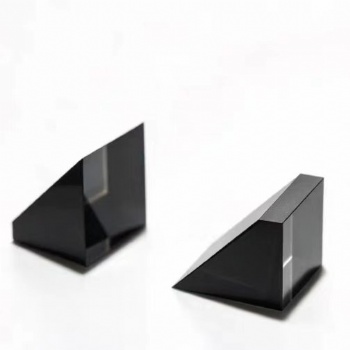
Edge blackening is a widely utilized optical technique aimed at reducing the effects of stray light, minimizing internal reflections, and enhancing the contrast of optical systems.
This process involves applying a light-absorbing material, such as black paint or coating, to the edges or non-working surfaces of optical components like lenses, prisms, or windows.
By blackening non-working surfaces, designers can reduce scattered light and absorb secondary reflections, thus enhancing imaging contrast and minimizing ghosting or flare.
Material: N-BK7 / UV Fused Silica
Dimensions (L x W x H): as per your need
Dimensional Tolerance: +/- 0.1 mm
Angle Tolerance: +/- 3 arcmin
Surface Quality: 40-20 Scratch-Dig
Surface Flatness: λ/4 @ 632.8nm
Clear Aperture: >90% of entrance / exit faces
Bevel: 0.2 - 0.5 mm x 45°
Coating - Transmitting Faces: AR Coating, R<0.5%
Coating - Reflecting Face: Aluminized + Black Paint Overcoat / or TIR, uncoated
Blackening: All non-transmitting surfaces blackened with matte black paint to reduce stray light
Chamfer / Edge:Edge-blackened, matte finish
Can be customized according to your requirements
spherical lens,plano-convex,plano concave lens,cylindrical lens,ball lens,halfball lens,optical windows,prism,optical filters.If you have any requirement,please contact us
Tags: spherical lens , plano-convex , plano concave lens , meniscus lens,cylindrical lens , ball lens , halfball lens , optical windows , prism , semi-circular prism , optical filters


 Send Email
 售前客服
 Skype