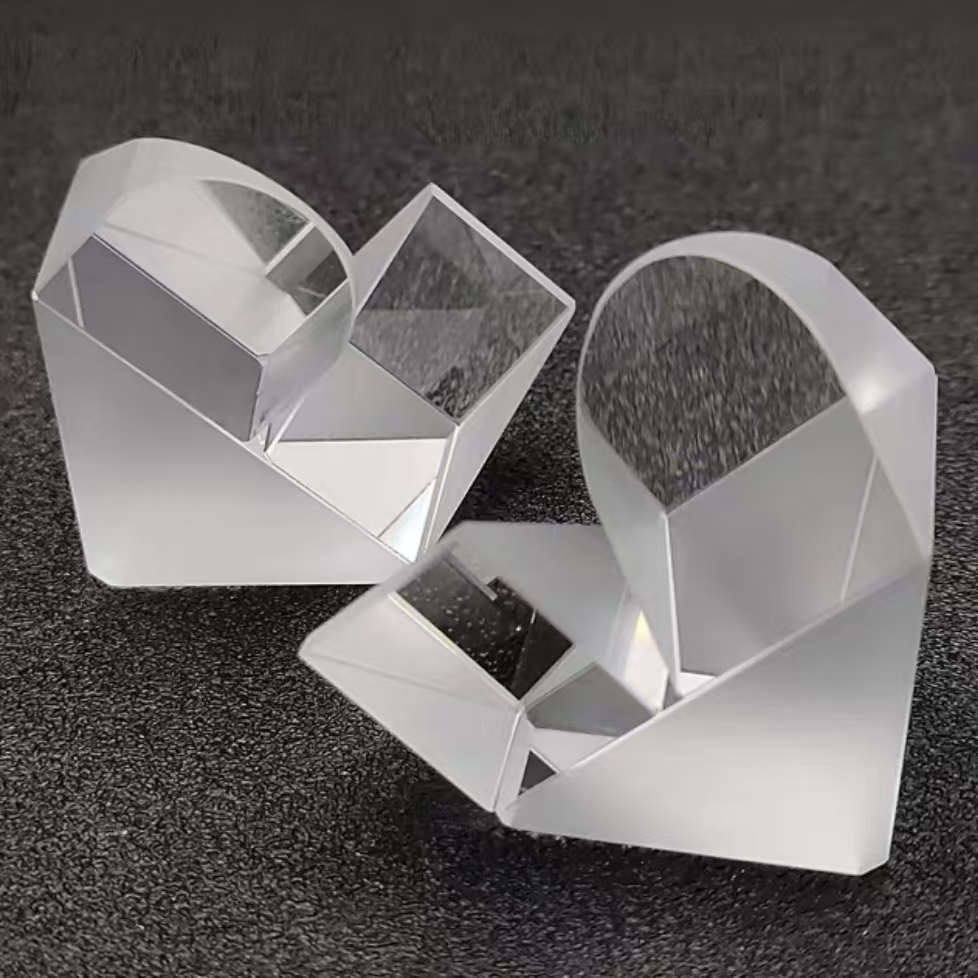
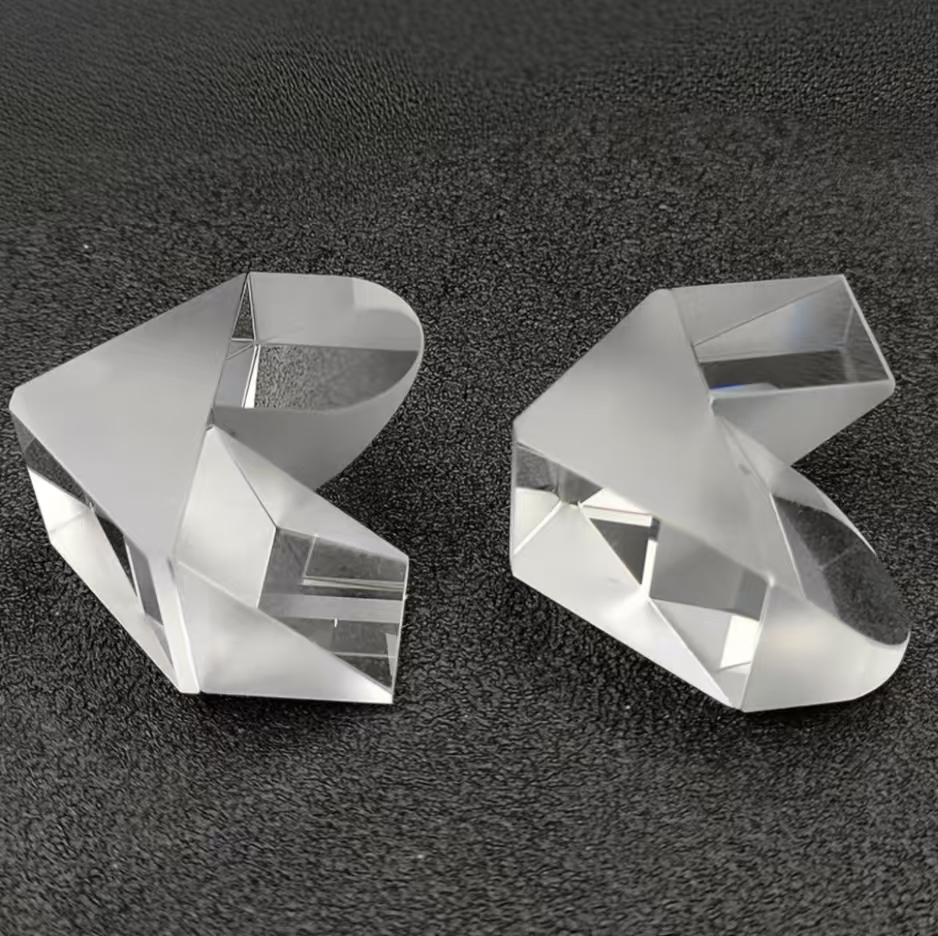
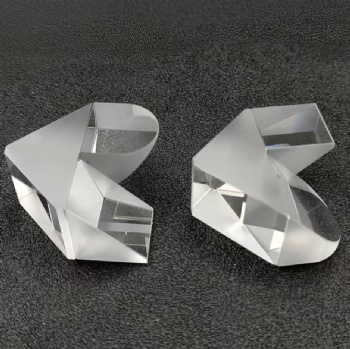
It is made from a piece of glass shaped like four right-angled reflecting prisms joined face-to-face in a twisted fashion. Light enters one flat face, is internally reflected four times (incident at an angle of 45º) from the sloping faces of the prism, and exits the second flat face offset from, but in the same direction as the entrance beam. The image is rotated 180° in the process, and for this reason the prism is used as an image erection system in some binoculars, and cameraviewfinders. The Porro–Abbe system reduces the lateral beam axis offset by 23% compared to a traditional double Porro prism system in binoculars.The prism is not dispersive since light enters and exits the prism only at normal incidence. Since the light is four times reflected, an even number of times, the image's handedness is not changed.
| Parameter | Value |
|---|---|
| Material | N-BK7 (or fused silica, F2, SF11 on request) |
| Apex angle | 60° ± 3 arcmin |
| Surface quality | 60/40 scratch-dig , 40/20 |
| Surface flatness | λ/4 per face at 632.8 nm |
| Clear aperture | ≥ 80% of face dimension |
| Dimensional tolerance | ±0.1 mm |
| Angle tolerance | ±3 arcmin |
| Refractive index (n_d, 587.6 nm) | 1.5168 |
| Abbe number (V_d) | 64.17 |
| Refractive index homogeneity | 1×10⁻⁵ (standard), 5×10⁻⁶ (precision) |
| Coating | Uncoated (standard); AR coating on request |
| Edge/wavelength range | 350–2000 nm (BK7 transmission) |
| Bevel | Protective bevel on edges |
| Face dimensions (common sizes) | 10, 12.7, 20, 25, 25.4, 30, 50 mm |
| Minimum deviation (n=1.5168) | ≈ 38.6° |
Can be customized according to your requirements
spherical lens,plano-convex,plano concave lens,cylindrical lens,ball lens,halfball lens,optical windows,prism,optical filters.If you have any requirement,please contact us
Tags: spherical lens , plano-convex , plano concave lens , meniscus lens,cylindrical lens , ball lens , halfball lens , optical windows , prism , semi-circular prism , optical filters


 Send Email
 售前客服
 Skype